 Beginnings
St Stephen’s Church was built to meet the needs of the growing population in South Dulwich following the establishment of the Crystal Palace on the top of Sydenham Hill and the arrival of the railway which made its way in a tunnel under Crystal Palace en route to Chatham and Dover.
The Church with its notable spire has been a landmark in Dulwich ever since it was painted by the famous French Impressionist, Camille Pissarro in 1870, two years after its Consecration.
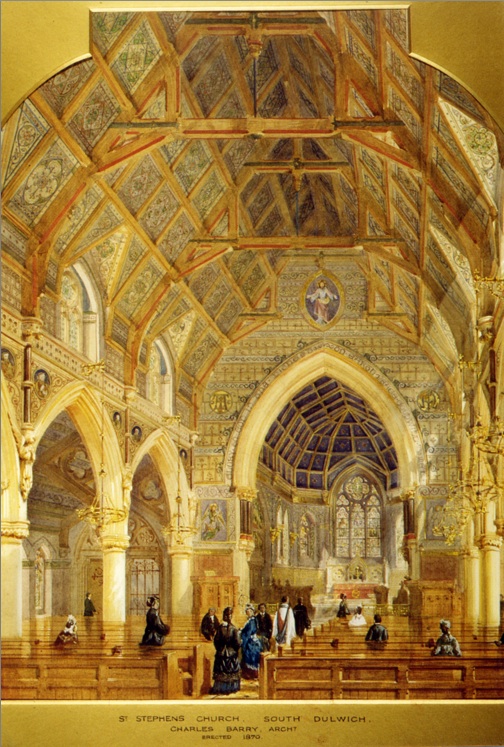
Designed by Charles Barry Jr (the son of the architect of the Houses of Parliament), the Church was of considerable beauty and was richly decorated in the Victorian Gothic style beloved of Pugin and Ruskin, as can be seen from a contemporary painting, probably the work of Barry himself.
The Church met the needs of the growing community south of the newly-built Dulwich College (also designed by Barry) and Dulwich Woods became the setting for many fine houses. Shortly after the completion of the building Sir Edward Poynter executed the fine fresco in the chancel commemorating the Trial and Martyrdom of St Stephen.
World War II
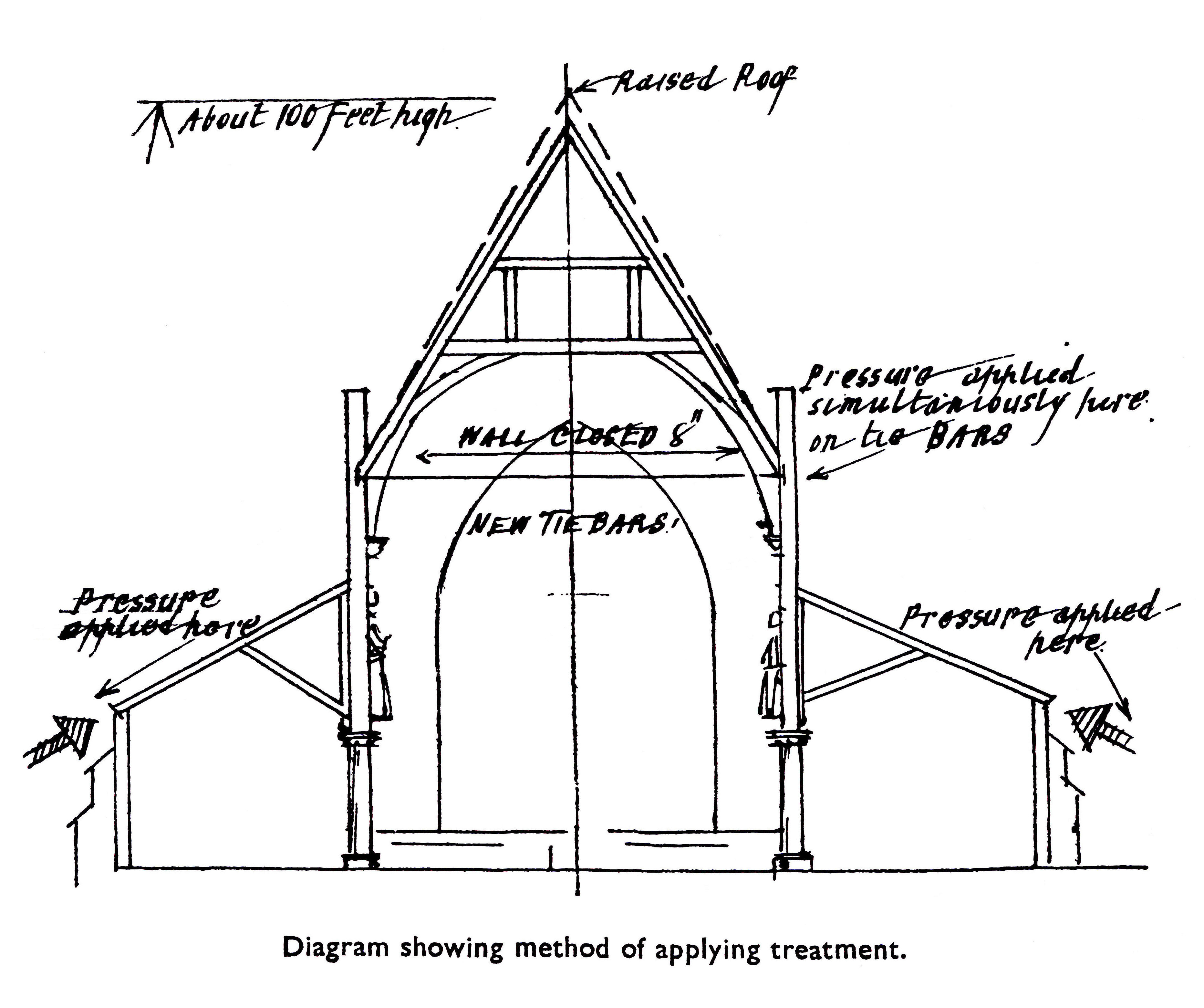
The church suffered serious war damage in 1944, caused by V1 ‘flying bombs’. Fortunately the building was saved, though not without anxious moments in 1946 when the walls began to lean outwards. This was the result of the pressure exerted on them by the roof which had almost been lifted off the building by the bomb blast.
An ingenious proposal by a young builder, Cecil Watkins, to squeeze the walls together through the use of jacks resulted in the walls being restored to their original position, since when they have been held together by unobtrusive tie bars inserted at intervals along the nave. This work was described in The Builder magazine as a ‘miracle’.
Nevertheless, all stained glass – with the exception of the east window – was destroyed.
The church became a Grade 2 Listed Building in 1972 ( List Entry Number: 1385417) and the War Memorial (originally commissioned following World War I) was similarly listed in 2017 (List Entry Number:1449908).
Recent Developments
The rich decoration of the interior of the Church was largely restored to mark the Church’s centenary in 1968 and, in the 1990s, there was a successful and sensitive re-ordering with the introduction of a stepped dais providing space for a nave altar. We built a separate church hall for the new Millennium which provides valuable community space, including for a nursery school, scouts and parties as well as events for the congregation. Then in 2003, the roof of the spire was renovated and the church interior was repainted. In 2022, we completed the installation of a new lighting and sound system.
Other artworks
In 1993, St Stephen’s was gifted a carved triptych depicting the Nativity. The work was designed and carved by the artist Charles Gurrey, whose other work includes figures above the West Door of Guildford Cathedral. Described as a ‘nativity frieze in oak’, it is normally kept on the north wall of the baptistery but is displayed under the nave altar during the Christmas season every year. The artist has portrayed the three kings in medieval dress and they crowd the scene. The shepherds are in modern dress and their sheep are placed in the foreground to represent the flock. Mary is completely absorbed in the child, while Joseph wonders at the attention of the shepherds towards the infant. The palm branch and the pile of stones in front of the crib are symbols of St Stephen, our patron saint.
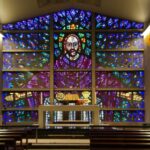
In 2024 we installed a beautiful set of stained-glass windows in memory of Dr Joan Greenwood OBE (1933-2019), a distinguished midwife and long-time churchwarden of St Stephen’s. Designed by renowned stained-glass artist Roland Mitton, the windows reflect themes closely linked to Dr Greenwood’s remarkable career and faith: the Nativity, the Annunciation, and the Visitation. Further details are available on the information sheet in the Lady Chapel.
Music has always been a major feature of worship at St Stephen’s and the weekday life of St Stephen’s. We have a choir made up of adults and a separate choir for young people, and we frequently host musical events and special services.
With a very generous legacy we were able to purchase a new concert grand piano, which is regularly used for professional recordings and piano practice, as well as concerts and services.
We are currently conducting an appeal for a new pipe organ, in place of the defunct pipe organ that was installed at the West end of the church some 20 years ago. For the time being, we are using an electronic organ. More information about the appeal is available at the back of the Church.
More information
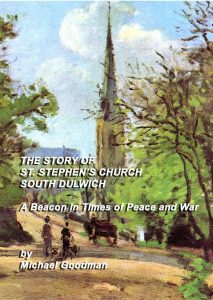
A longstanding member of the congregation, the late Michael Goodman, wrote a history of the church entitled The Story of St Stephen’s, South Dulwich, A Beacon in Times of Peace and War: The History of the Building and the People who lived and worshipped there 1868-2007. The book contains an account of the contributions made by parishioners to the Life of the Church over the past hundred and fifty years and the relationship with the Dulwich Estate. Copies of this book are obtainable from the Church.