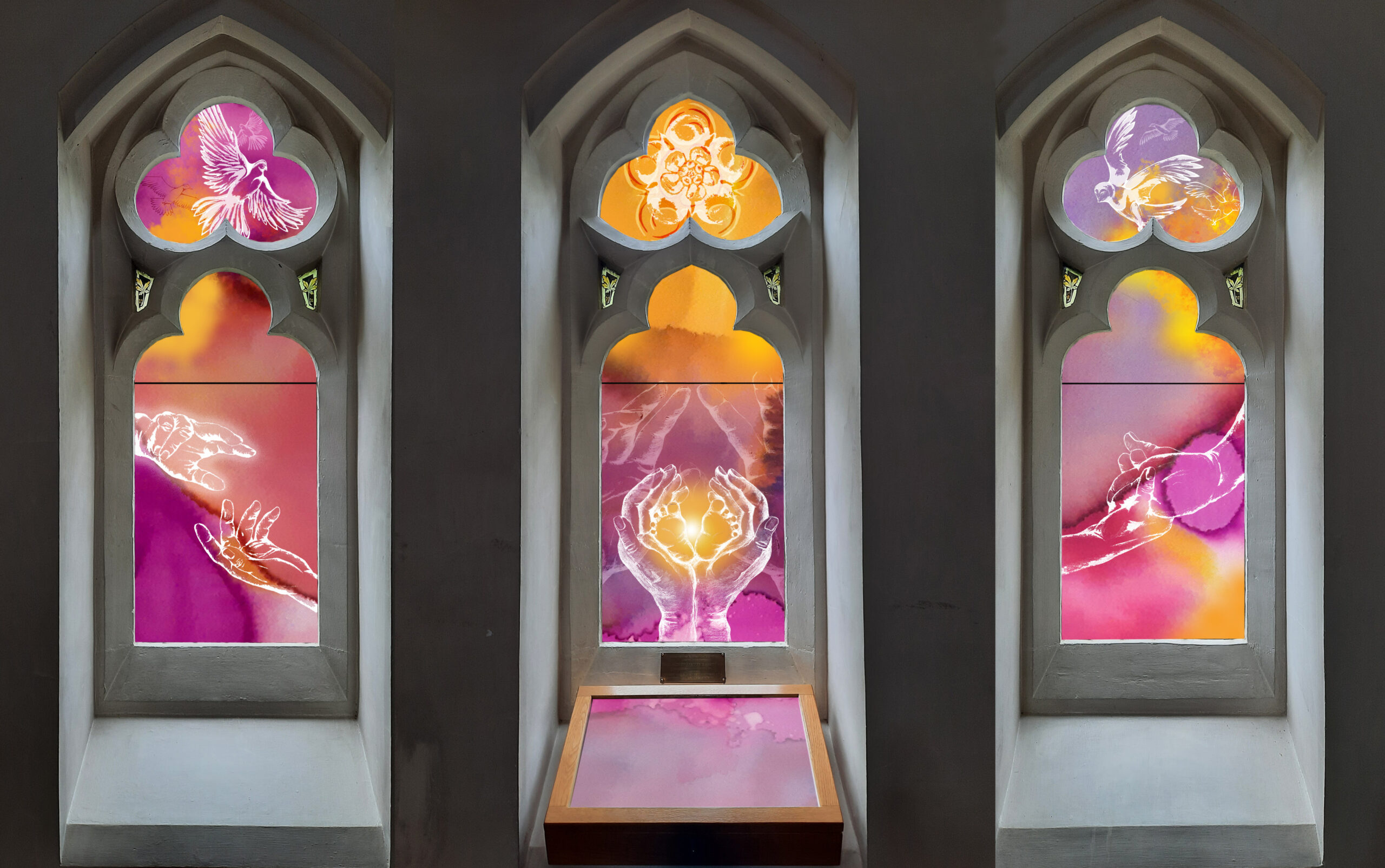
 I view the three lancets and tracery as forming one “canvas”, united whilst giving each space its own content.
I propose a very simple design, unified by colour and allowing for freedom of interpretation.
The success of my design relies on understanding that creating a spirituality of space, seems as important as the themes depicted.
To create this I propose an overall colour concept that is very warm, soft, embracing to depict themes that are united holistically in the simplest of ways.
Central to my design is an appreciation of courageous and strong women, like Joan Greenwood, and of women’s stories from the Bible, and the overall colour concept is an expression of this. In general, the feminine aspect should be prominent and visible in the whole design of the window. The colours flow into each other softly: gentle yet clear in their delineation. With different shades of fuchsia, magenta, lavender, orange and yellow I want to convey attributes such as strength, warmth, confidence, being held, sensitivity, willpower and responsibility. These are all attributes that, as I wrote in the expression of interest, were also close to the heart or intrinsic to Joan Greenwood, an extremely warm-hearted and generous person to whom these windows are to be dedicated.
Holding and being held is the focus of my design. Hands were already visible in the first signs created by man, in the cave paintings. With our hands we create. With our hands we touch, with our hands we meet, with our hands we hold. Together head, heart, hand is a trinity that makes us as human beings.
Midwifery is one of the oldest female professions. The German word for midwife, “Hebamme”, is derived from the words hevan “to hold” and ana “ancestor”, in reference to the woman/ancestor/grandmother who assisted and held the new-born.
In life we always need people to pick us up or hold us. It is not only important to be held during birth, – people of all ages and genders often long for this feeling.
For each theme in the three windows, there is a separate hand gesture, an overarching lyrical narrative.
THE ANNUNCIATION – left hand lancet
Here the “blessing hand” of the angel, as quoted in the history of art and representation of the Annunciation, enters into the picture. The hand is represented very transparently, a generous, easily flowing gesture with clear delimitation. In response Mary’s hand radiates something definite and is receptive. She accepts! A defining moment of history.
THE VISITATION
right hand lancet Mary seeks out Elizabeth to share the good news with her and also
to confide in her. They both face the fact that God had other plans for them and they have to cope with these circumstances. As human beings, we know such situations only too well. Times when everything comes differently are often those times when we pray as well as ask for security and guidance. Holding hands gives comfort and confidence.
THE NATIVITY – central lancet
This is the main focus of the scheme: The foreground gesture is unmistakable, that of the new-born, a bringer of salvation, lovingly and gently held by the mother (or perhaps the midwife: this can be interpreted freely).
This universal message of care, of trust, and of love is protected by hands that hold the whole wide world. Both pairs of hands are securing, lifting, and offering. The rising yellow in the centre, a symbol of light, of the bringer of salvation, of new beginnings, and of uplift is clearly evident in the design.
THE TREEFOILS
Joan Greenwood herself is also clearly acknowledged in these spaces.
On the one hand, she is anchored by the white rose (the emblem of Yorkshire) in the centre trefoil windows a reminder of her roots. Joan was proud of her heritage. (The floral element of the white rose also ensures that the existing Victorian stained glass remnants are incorporated into the design.)
The central trefoil is flanked by birds. Joan travelled to the Scottish Hebridean Islands as an amateur ornithologist. A place, it seems, where she could recharge her batteries and which always gave her new energy.
In this context, the birds illustrated are a symbol of free thought, of willpower, faith and, last but not least, transcendence, the connection to the divine. The two birds can also represent the Hebrew midwives Shifra and Puah. Because of their trust in God, Shifra and Puah played an essential and strong-willed role in the biblical stories.
CONCLUSION
The simplicity of the design is its strength and will allow diverse viewers from all backgrounds to enter with his/her interpretation based upon their personal circumstances and needs.
The chosen themes, Annunciation, Visitation and Nativity, are dedicated on the one hand to Mary and on the other hand to the Incarnation of God – to life. The themes also symbolize the connection between heaven and earth, between the material and the immaterial, the profane and the spiritual.
The modern Joan Greenwood window design inevitably contrast with existing windows. Yet it fits into the genius loci of the church, which is characterized by a clarity, brightness and transparency.
The design is intensely coloured and yet glowing and bright. This will allow as much light as possible to shine through, bathing the surrounding area for Morning Prayer in a spiritual, warm atmosphere.
If commissioned I would use mouth blown flashed glass, and I enclose small colour samples for you to view.
If commissioned I would be very happy to discuss details to make agreed changes, and would be available for discussion along with clarification of all parts of the process at all times.