St Oswald
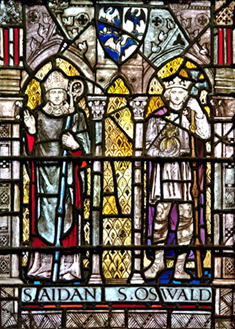

Detail from a window in Newcastle Cathedral.
This image was first published on Flickr. Original image by Fr Lawrence Lew, O. P.. Uploaded by Ibolya Horváth, published on 24 April 2017. The copyright holder has published this content under the following license: Creative Commons Attribution-NonCommercial-NoDerivs.
August 5th is the feast day of St. Oswald, someone Christians in England have a lot to be thankful for.
Imagine you are watching drone footage from 616 (impossible I know) looking down upon a small boat sailing from the Island of Mull on the west coast of Scotland to the tiny island of Iona. Among the passengers is a boy called Oswald, the exiled son of Aethelfrith, Anglo-Saxon king of Northumbria, recently killed in battle. On Iona, there is an Irish monastery and the monks living there will offer Oswald refuge. More significantly, they will educate and baptise Oswald after he converts to Christianity.
Whilst in Scotland, Oswald proved to be a skilled soldier and in 633 he returned to Northumbria where he defeated the occupying Welsh king, Cadwallon, in what is known as The Battle of Heavenfield. Before the battle Oswald ordered his men to make up a wooden cross. He held the cross upright in a hole while his soldiers heaped soil around it. Then they all knelt down and prayed for God to help them defeat Cadwallon.
Shortly after becoming king, Oswald asked the monks of Iona, led by St Aidan, to send missionaries to establish a Christian community and a base for Christian mission for the kingdom of Lindisfarne in Northumbria. With Oswald’s support, Aidan and his missionaries achieved great success in spreading the Christian faith in England.
Sadly the reign of Oswald was short-lived. On 5 August 642, he was killed in battle by Penda, king of the Mercians, at Maserfield, now Oswestry, in Shropshire. The dead king was venerated as a martyr of the Northumbrian church and was made a saint.
James Fraser, server at St Stephen’s – 3 August 2025